HOW ELUCIDE WORKS
Turn fragmented data into trusted data products.
Without moving sensitive data to the cloud.
elucide connects to the systems you already run, processes sensitive data inside your own network, and gives your teams one place to build, govern and operate reliable data products.
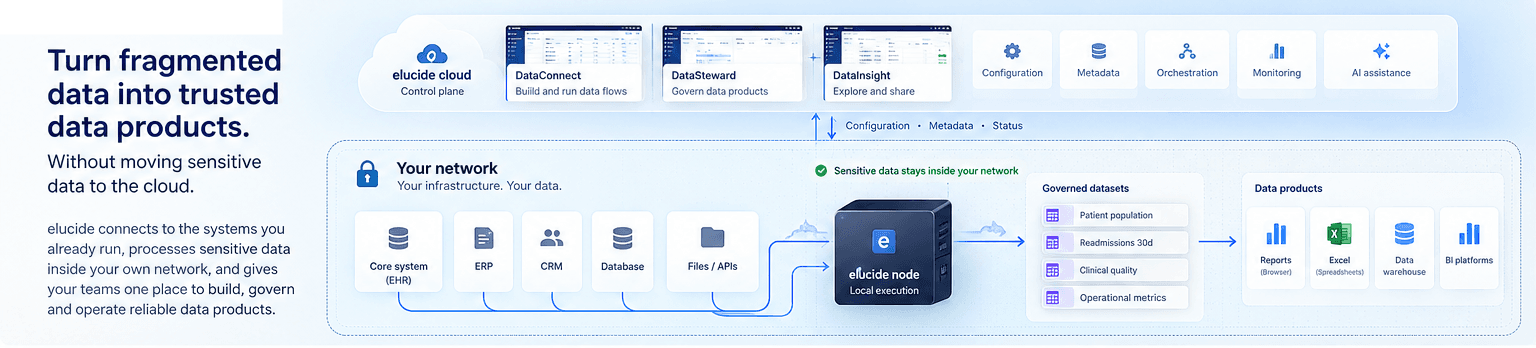
The cloud coordinates.Your local elucide node does the work.Your sensitive data stays where it belongs.
Between the cloud and your node, only
- configuration
- metadata
- status
- orchestration
01 · Connect · DataConnect
Connect to the systems you already have.
No new central data lake required.
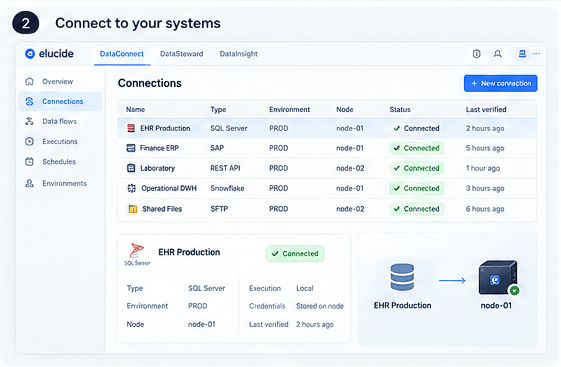
A local elucide node connects to the systems you approve, inside your own network. You configure a connection in DataConnect; the node holds the credentials and does the connecting.
Sources
- SQL / ODBC databases
- APIs
- ERP systems
- EHR and operational applications
- Files
- Existing data warehouses
Connections are configured through elucide, while credentials remain within the local environment.
02 · Process locally · elucide node
Process the data where it lives.
The cloud tells the node what to run. The node works with the data.
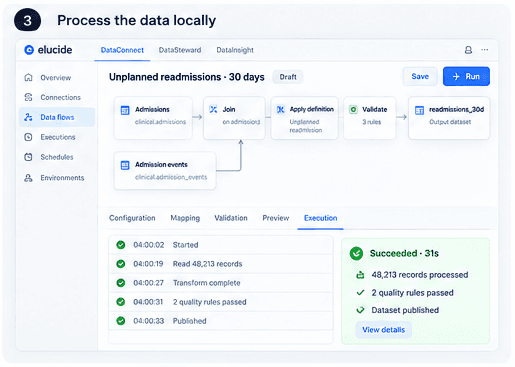
You build a DataFlow in DataConnect. The cloud keeps its definition and schedules it; the elucide node runs it. Every record-level operation happens on the node, inside your network.
A DataFlow, for example
- Read admissions
- Combine admission events
- Apply a business definition
- Validate the output
- Publish a governed dataset
03 · Govern · DataSteward
Turn pipelines into governed data products.
A dataset should mean more than a table.
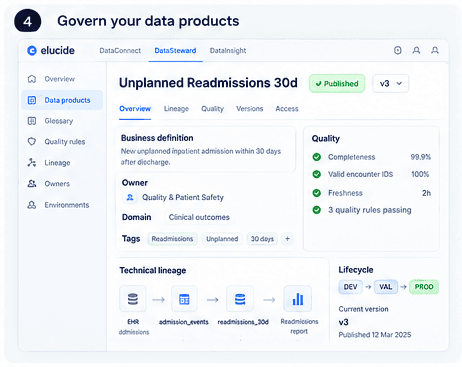
DataSteward attaches business context to technical data, so what you publish is a data product with a meaning and an owner -- not just the output of a pipeline.
Every data product carries
- Definition
- Ownership
- Lineage
- Quality
- Lifecycle
- Version
- Publication status
Unplanned Readmissions 30d
Definition: new unplanned inpatient admission within 30 days after discharge.
Owner: Quality & Patient Safety
Quality: 99.9%
Lifecycle: DEV → VAL → PROD
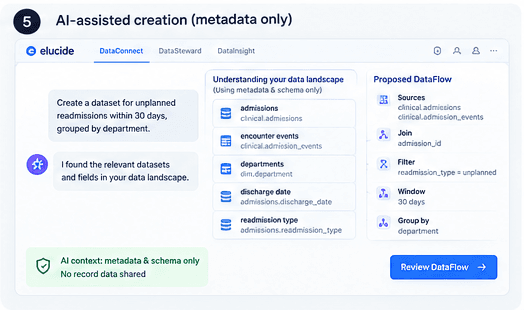
04 · AI-assisted creation · DataConnect
Let AI understand the data landscape — not the sensitive records.
Ask for the dataset you need. AI assistance works from what the platform already knows about your data -- schema, metadata, definitions, relationships, lineage and approved business rules -- finds the relevant sources and proposes a DataFlow: fields, joins, filters, aggregations, validation rules and reporting logic. You review it before anything runs.
Example request
Create a dataset for unplanned readmissions within 30 days, grouped by department.
AI context: metadata and schema
Raw sensitive records remain local
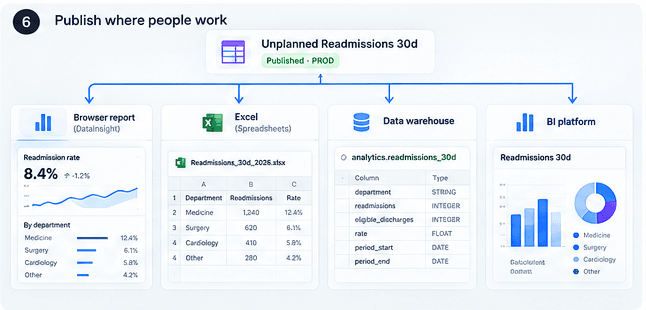
05 · Publish · DataInsight
Publish where people already work.
A governed data product should be usable in the tools your organisation already has. The node delivers it locally, to each approved channel, from the same governed source -- so every channel shows the same number.
One governed data product
- Browser report
- Spreadsheet
- Data warehouse
- BI platform
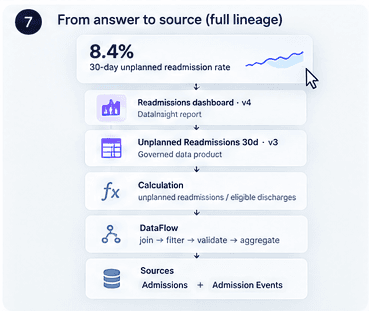
06 · Trace back to source · DataSteward
From answer to source.
Every published number should be explainable.
When someone sees a metric, elucide can connect it back through the data product, transformations and definitions to the systems that produced it.
Lineage
- 8.4% KPI
- Dashboard
- Governed data product
- Calculation
- DataFlow
- Source systems
ARCHITECTURE
Cloud control. Local execution.
For those who want the detail: the two halves of elucide have different jobs, and the line between them is the line your sensitive data does not cross.
elucide cloud · control plane
- Configuration
- Metadata
- Orchestration
- Versions
- Deployment lifecycle
- Monitoring
- AI assistance
Local elucide node
Inside your network
- Connections
- Credentials
- Local DataFlow execution
- Record-level processing
- Local DataStore
- Delivery to local destinations
The cloud needs to understand the data landscape. It does not need to possess the sensitive data.
What this means in practice
- No elucide web page ever asks for a database credential, server address or account name.
- Setup happens once, on your own server, over a local socket (local IPC) -- not in a browser.
- The node reports job status and metadata outbound; the cloud sees run outcomes and freshness, never records or secrets.
LIFECYCLE
Built for the full lifecycle.
DEV
Build and iterate
VAL
Validate logic and output
PROD
Operate and monitor
Configuration is promoted between environments.Production data is not copied backwards.
From data to clarity.
Your organisation already has the data.
elucide gives you the layer to connect it, understand it, govern it and turn it into reliable data products — without surrendering control of the underlying sensitive information.